Back to blog

Found this useful? Add Novelty as a preferred source and see more of our content when you search on Google.
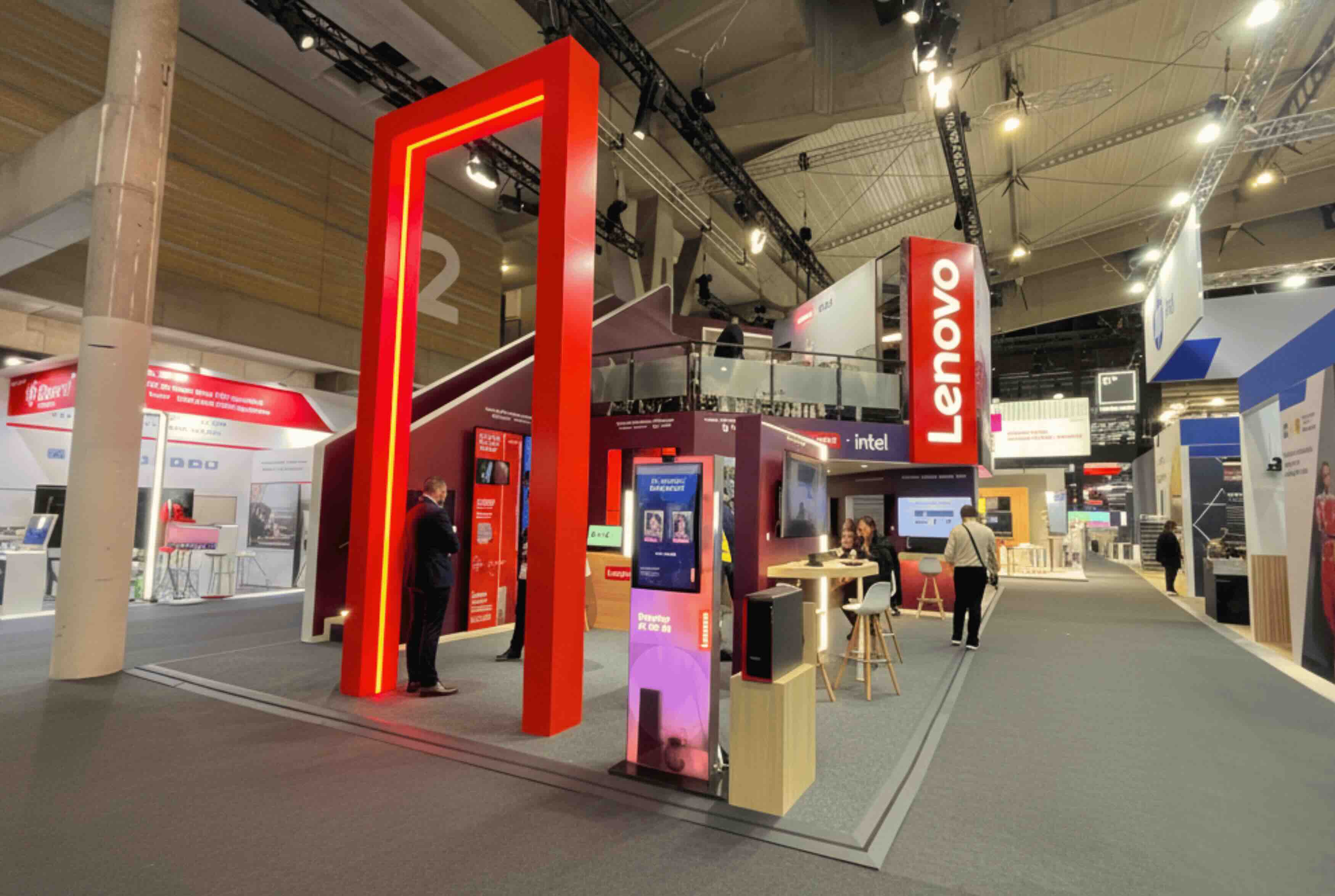
The audiovisual technical production ISE project for Lenovo’s stand at ISE 2026 was delivered through a precise integration of rigging, lighting and invisible cabling, maintaining a clean aesthetic within a two-story space at Fira Barcelona.
At a trade show like ISE 2026, where every brand competes for the attention of a highly technical audience, the infrastructure must be flawless—and practically invisible. It needs to support the experience, reinforce the brand, and disappear from the visitor’s view. That was the challenge behind the Lenovo stand: combining large-format screens for trade shows, corporate lighting and suspended structures within an open, minimalist design free of visual interference.
To achieve this, Novelty Spain developed a technical solution based on three key pillars: safe trade show stand riggingfor a double-deck structure, precise LED lighting for exhibitions to avoid reflections on displays, and a power and DMX signal distribution for stands designed to keep all cabling completely hidden.
The result was a clean, organised and technically robust stand, designed to let the brand speak clearly in one of Europe’s most demanding technology showcases.
This article takes you behind the scenes of this audiovisual setup for trade fairs in Barcelona, explaining step by step how these technical challenges were solved—and how a brand can truly stand out at ISE.
Technical AV production ISE: Lenovo stand at a glance
- Event: ISE 2026 – Integrated Systems Europe
- Client: Quattrocento Diseño
- Brand: Lenovo
- Date: 3–6 February 2026
- Location: Fira Barcelona Gran Via
- Space type: Two-story exhibition stand
- Industry: Technology / Innovation
- Audiovisual provider ISE Gran Via: Novelty Spain
- Technical production: Rigging, lighting, electrical distribution and AV support
- Technical goal: Integrate all AV infrastructure without altering the stand’s open design
The stand combined interactive demos, collaboration solutions and a visual presence designed for continuous visitor flow. Its two-level architecture allowed different experiences—from product zones to meeting areas—while maintaining a cohesive, open aesthetic aligned with Lenovo’s global identity.
The key was to integrate the entire technical infrastructure while keeping the visual space clear. Nothing could interfere with the design, and every element had to support the brand’s technological narrative without overpowering it.
What are the technical challenges of a two-story trade show stand?
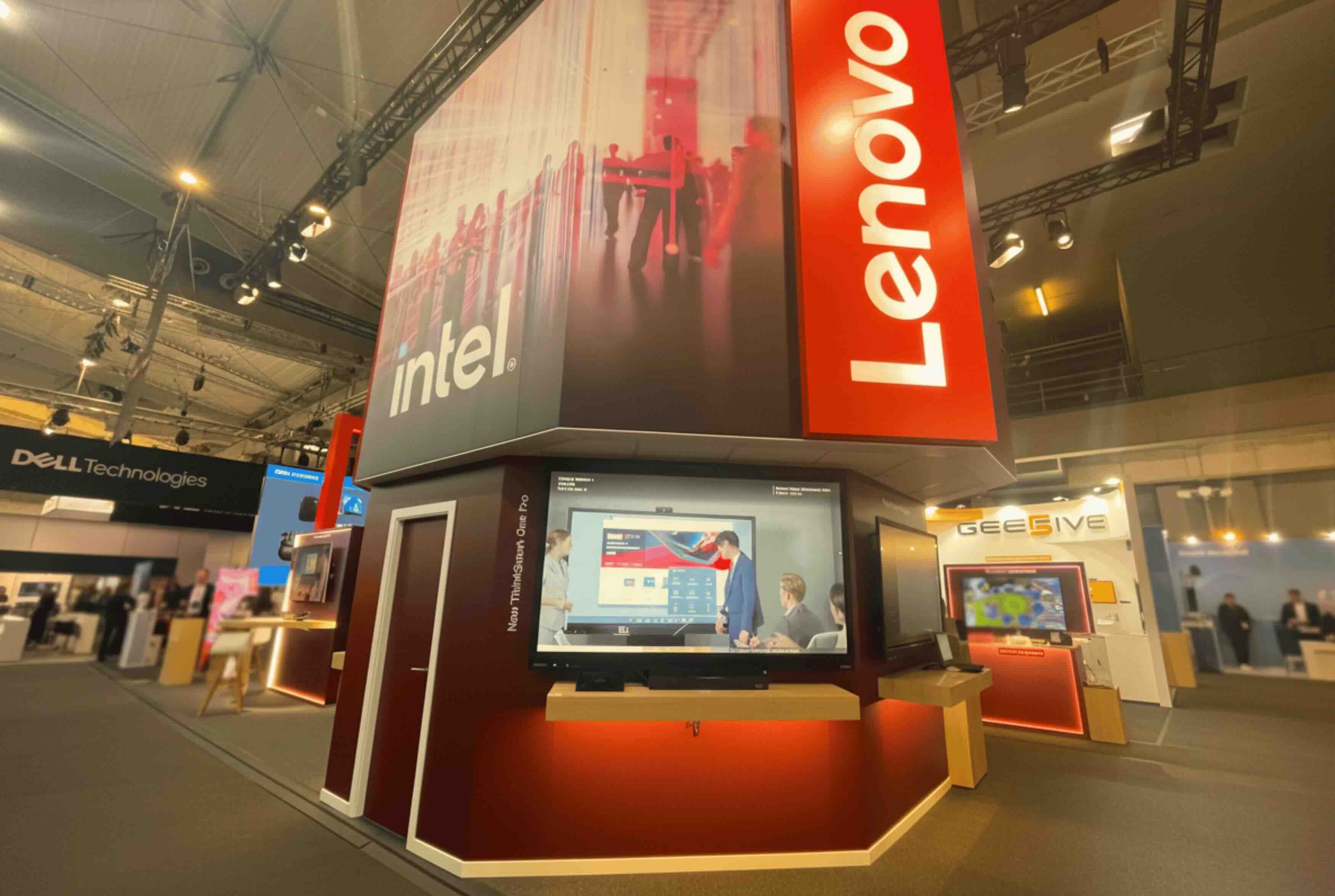
Image Source: Novelty Spain
A two-story stand offers more surface, more visibility and more possibilities—but it also significantly increases technical complexity.
At ISE 2026, this directly impacts lighting and rigging for corporate events, as well as installation planning. The structure must safely support suspended loads, lighting must function across multiple levels without creating reflections, and the entire system must integrate seamlessly into the design.
Another key challenge is cabling. In an open stand, every power and signal route must be planned in advance to avoid disrupting both aesthetics and visitor flow. The more visible the technical setup, the weaker the brand experience becomes.
That’s why these types of projects require precise coordination between design, architecture and technical AV production ISE teams. It’s not just about installing equipment—it’s about integrating it so everything works reliably while remaining almost invisible.
For Lenovo, this integration was essential. The stand needed to maintain a clean, high-tech image, with screens as the focal point, clearly defined zones and an intuitive spatial layout across both levels.
How AV production was integrated into Lenovo’s trade show stand
The technical production focused on integrating rigging, lighting and power distribution in line with the two-level design. The goal: maintain a clean aesthetic, ensure invisible cable routing and provide optimal lighting conditions across both floors.
This required:
- A rigging structure capable of supporting suspended loads
- Balanced LED lighting for exhibitions across demo and circulation areas
- Strategic DMX signal distribution for stands and power planning
- Chauvet Ovation Rêve E-3 for logos and focal points
- Elation KL Fresnels for uniform base lighting
- SGM Q7 for ambient lighting without unwanted reflections
- RJ45 signal transmission
- Adaptation to 4-line XLR
- A single DMX universe controlling all devices
Each discipline was developed in parallel to ensure a seamless and functional environment for visitors.
1. Rigging for two-story trade show stands
The trade show stand rigging system was designed to support the lighting grid above the double-deck structure with maximum stability.
The setup included 12 Liftket 250 kg motors with D8+ certification, controlled via a 12-channel system. These D8+ hoist motors for trade fairs ensured safe load handling and met the strict requirements of exhibition environments.
The main structure used Expotruss X4K-30 truss in black, helping visually integrate the rigging into the venue ceiling while avoiding interference with the stand’s branding.
The result: a solid, discreet and perfectly aligned structure within the overall design.
2. LED lighting for exhibitions: how to light a two-story exhibition stand without reflections
A key question in this project was how to light a two-story exhibition stand without affecting screen visibility.
Lighting was designed to enhance Lenovo’s presence while avoiding reflections on displays—critical in a tech-driven environment where screens are central.
The solution combined different fixtures with specific roles:
Fixture placement, height and angles were carefully adjusted to balance visibility, comfort and brand presence across both levels.
This approach ensured that lighting guided the visitor journey while highlighting products without compromising the stand’s clean aesthetic.
3. How to hide AV cabling in open trade show stands
One of the most delicate challenges was powering and controlling the entire system without compromising the stand’s open design. Power distribution was managed through a 32A PowerBox, separating rigging and lighting circuits to maintain a clean and organised setup.
Signal distribution relied on a hybrid system designed to reduce cable runs and simplify installation across both levels. This DMX signal distribution approach helped maintain a visually clean deployment throughout the stand.
The result was a stable, efficient and virtually invisible technical infrastructure fully aligned with the stand’s minimalist design.
The impact of technical AV production on brand experience
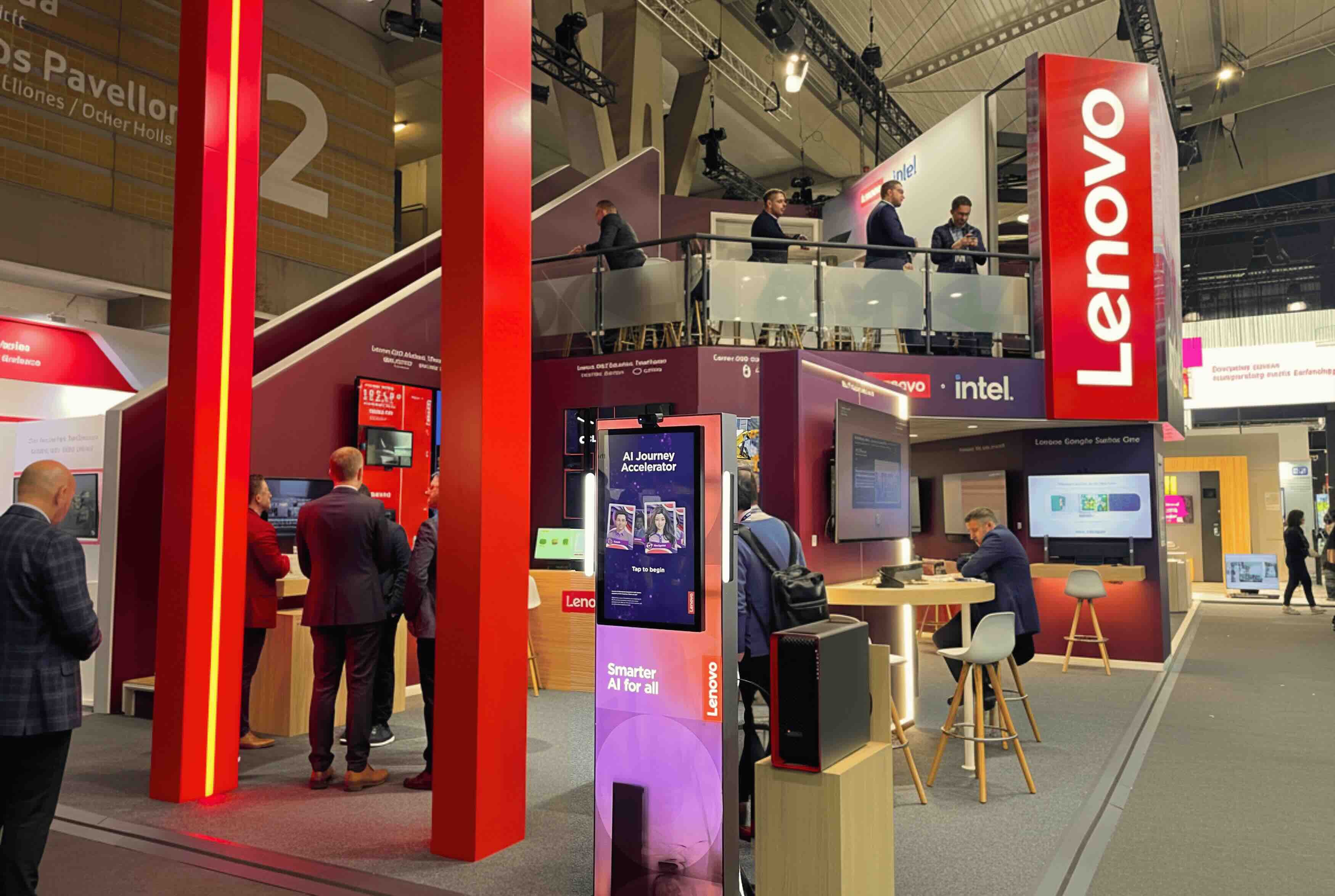 Image Source: Novelty Spain
At an event like ISE, technical production directly shapes how a brand is perceived.
Stable rigging, precise lighting and invisible cabling allow the message to reach visitors without distractions. When the technical layer disappears, the experience becomes more fluid—and the stand communicates professionalism and trust.
For Lenovo, this translated into:
- More readable large-format screens for trade shows
- Clear demo areas without interference
- A clean visitor journey across both levels
This not only improves the visitor experience but also reinforces Lenovo’s brand values: precision, clarity and innovation.
In this context, technical AV production ISE becomes part of the stand’s visual language. When executed correctly, it strengthens the brand’s message and elevates the entire experience.
FAQs about trade show stand production at ISE