Back to blog

Found this useful? Add Novelty as a preferred source and see more of our content when you search on Google.
In event planning, success is just measured through applause. It’s measured in technical clarity, visual impact and the ability to move an audience without unexpected issues. All of that starts long before the lights go on with a well-planned audiovisual event budget.
For event agencies and brand managers juggling multiple cost lines, an audiovisual event budget can look like nothing more than a spreadsheet full of figures. In reality, it’s a strategic roadmap that defines how the event will be experienced and felt. A clear, detailed and well-justified breakdown makes it easier to take quick decisions, avoid unexpected costs and defend the investment internally.
According to the 2024 ConferenceDirect and Knowland report, the main challenge is “maintaining cost control without compromising the experience”, placing the technical budget among the year’s top priorities. That’s why knowing how to interpret an audiovisual event budget isn’t just useful but essential if you want to avoid sacrificing quality for price or creativity for improvisation.
In this article, we’ll break down each component, highlight common mistakes and give you the tools you need to analyse, justify and optimise your audiovisual production budget with confidence.
Key cost components in an audiovisual event budget
An audiovisual event budget may seem complex at first glance, but when broken down properly, it reveals the real value that each line item brings to the overall event experience. These are the core blocks that make up most professional AV and event production budgets.
Technical audiovisual production
This is the heart of the project. It includes technical direction, AV system design and the coordination of all elements involved. A comprehensive audiovisual production budget covers everything from pre-production planning to real-time supervision during the event.
Why does it matter? Strong technical direction ensures that all elements such as screens, sound and lighting work as a single, cohesive system aligned with the event script and objectives.
Lighting, video, sound and rigging: common breakdowns in audiovisual budgets
Each of these components can usually be broken down as follows:
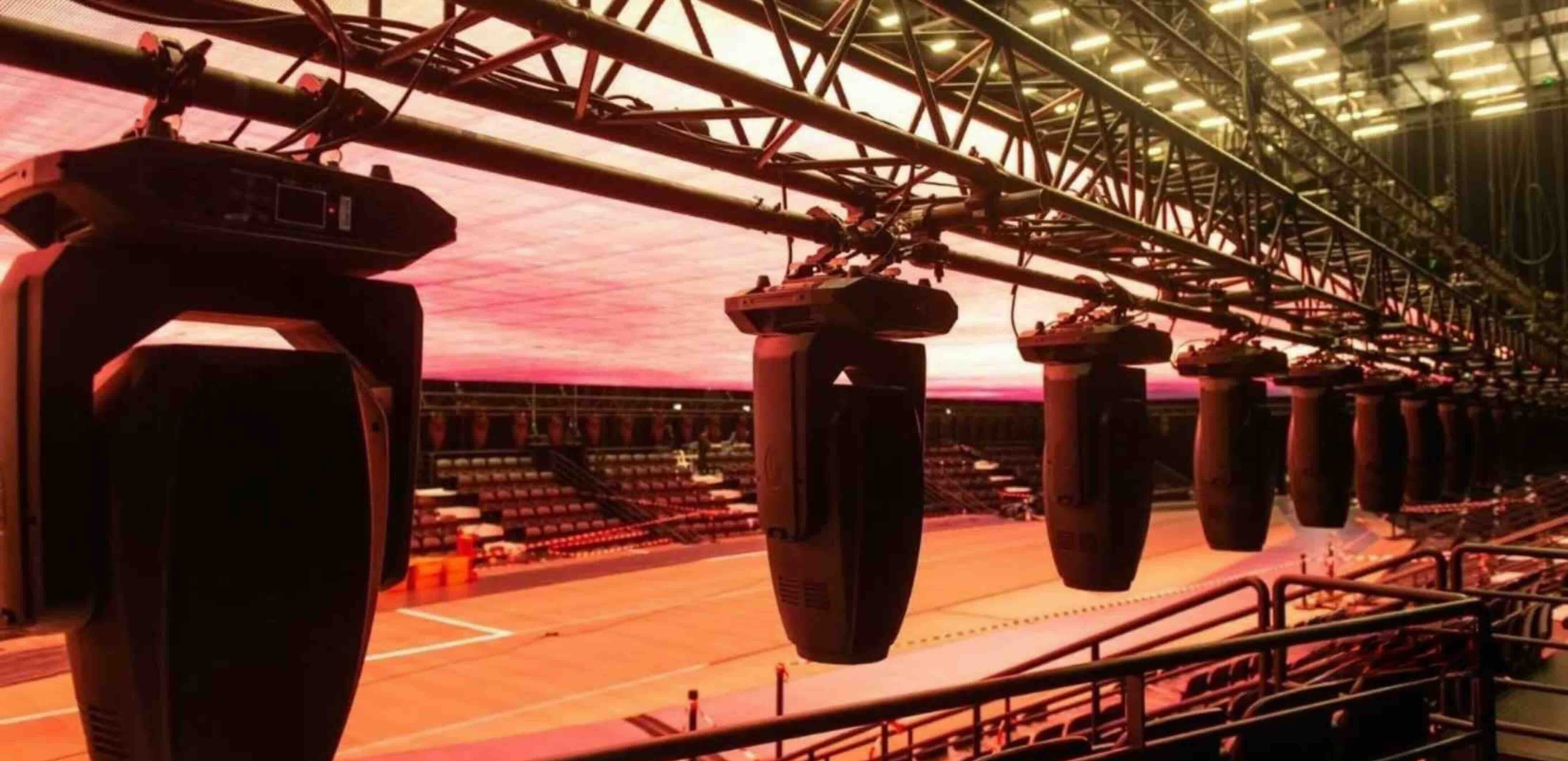
- Lighting: spotlights, wash lights, moving heads, special effects, lighting control consoles, etc.
- Video: LED screens, projectors, media servers, video mixers, content playback systems.
- Sound: loudspeakers, subwoofers, microphones, mixing desks, wireless systems.
- Rigging: truss structures, motors (when required) and load-bearing systems.
It’s essential that the provider specifies abilities, equipment brands and technical positioning, so you know exactly what you’re including within your audiovisual event budget.
Transport, installation and technical staff
These three items often appear at the end of the budget yet they can represent a significant portion of the total event production spend:
- Transport: equipment logistics, technical vehicles, possible venue access fees.
- Installation and dismantling: number of working days, crew hours, night shifts or public holiday work.
- Technical staff: lighting, sound and video technicians, riggers, system engineers and on-site operators.
If these items aren’t clearly mapped out, they may appear later as additional charges.
How to interpret and compare multiple audiovisual budgets
When requesting several quotes for the same event, it’s easy to fall into the trap of comparing only final prices. The real value, however, lies in the details. This means looking at what each audiovisual event budget includes, and what it leaves out.
How to evaluate an audiovisual event budget beyond the cost
A cheaper quote isn’t always the better option. Make sure that you assess:
- The technical level and brands of the equipment.
- The experience of the technical team involved.
- The provider’s ability to react to unexpected issues.
- The technical documentation delivered (plans, riders, simulations).
Elements such as technical redundancy, live maintenance and specialised operators make a major difference to the final execution of the event.
Essential elements of a complete audiovisual production budget
A professional provider should always offer:
- A clear breakdown by technical areas (lighting, sound, video, rigging, etc.).
- Installation, dismantling and on-site support hours.
- Clear explanations of each technology used.
- Logistics costs and potential extra charges.
A high-quality audiovisual production budget is also supported by additional documentation including technical drawings, visual proposals (renders or simulations) and recommendations tailored to the venue.
Common mistakes when analysing audiovisual production budgets
Even experienced professionals can make mistakes when reviewing a technical audiovisual production budget. These errors don’t just affect costs. They can compromise the quality and smooth running of the event.
1. Failing to identify hidden costs
This is one of the most common mistakes. Some budgets appear cheaper because they exclude items that are later billed separately, such as:
- Live streaming or broadcast services.
- Extended event hours.
- Additional technical staff due to script changes.
- Contingency plans for weather or technical failures.
If alternative scenarios aren’t included or reviewed upfront, last-minute charges are likely to follow, often at the expense of the overall experience.
2. Choosing based on price without considering event impact
Cutting costs in sound, lighting, rigging or video may seem logical, but it has direct consequences:
- Poor stage visibility.
- Insufficient or unclear audio.
- Unreliable or outdated equipment.
- Longer installation times, increasing the risk of delays.
Your audiovisual event budget is an investment that directly affects how the audience perceives and remembers the event.
3. Not asking for clarifications or technical alternatives
Every event is unique. If a line item feels vague (for example, “LED screen” without size or resolution), ask for clarification. You can also request alternatives, such as:
- Option A: standard equipment.
- Option B: higher-impact technology.
- Option C: a hybrid or space-adapted solution.
An experienced provider should be able to propose technical options aligned with your objectives, without compromising quality.
How to defend your audiovisual event budget internally or with clients
Knowing how to interpret an audiovisual event budget is only half the job. The other half is defending it with solid arguments in front of decision-makers, whether that’s a client, a finance department or a management committee.
First, adapt your language to your audience. A finance director will respond better to efficiency and return metrics, while a client will want to visualise the emotional and visual impact of the event. Talk about results as well as equipment and costs:
- What experience will the audience live thanks to this AV design?
- What risks are eliminated with professional technical audiovisual production?
- What return can be measured in attention, interaction or brand recall?
Visual comparisons (renders, videos, simulations) can clearly show the difference between a robust technical proposal and a more limited one. Industry data also helps reinforce the argument that events that prioritise audiovisual production consistently achieve higher engagement and stronger brand positioning.
Defending a budget isn’t about justifying a cost but about explaining value. And when that value translates into a memorable brand experience, the return speaks for itself.
What’s next? Request your audiovisual event budget with professional criteria now
An audiovisual event budget is more than a list of numbers. It’s a decision-making tool, a guide to creating impact and a way to anticipate results. Understanding it allows you to stay in control, defend your choices and elevate the technical standard of your events.
Are you currently reviewing budgets for your next event? Request a personalised quote with expert technical support and make sure that your event organization decisions are based on clarity, quality and long-term value.