Back to blog
.png)

Found this useful? Add Novelty as a preferred source and see more of our content when you search on Google.
A gobo is a metal or glass plate with a shape engraved into it that is placed in front of a light source. When positioned between the light and a surface, it acts as a filter, allowing a beam of light to project the chosen shape onto a wall, floor, stage or any other surface.
In AV production and corporate events, this technique transforms walls, stages, floors and scenic elements into active parts of the visual design, helping to reinforce atmosphere and brand identity. Gobos can be used in static lighting fixtures, such as profile spotlights for fixed projections or in moving-head spot fixtures when the projection needs to move and create dynamic effects.
A simple way to understand what a gobo is is to think of the Bat-Signal from the Batman films and comics. Picture a circular beam of light projecting the superhero’s logo into the sky. That is essentially the same principle behind a gobo.
Long before modern lighting technology existed, people used shadows cast by their hands or objects to tell stories. The concept remains unchanged, but the technology has evolved.
Today, gobos have become one of the most versatile tools in event lighting, capable of projecting anything from a company logo to textures that completely transform a venue. In this article, we’ll explore the different types of gobos, how the projection equipment works and how you can use them effectively at your next event.
What does the term gobo mean?
The term gobo has two commonly accepted origins:
- “Goes Before Optics”: referring to the position of the plate within the lighting fixture, placed directly before the optical system.
- “Graphical Optical Blackout”: referring to its function of blocking part of the light so that only the desired shape is projected.
Both definitions describe the same concept from different perspectives: a component positioned before the optics that selectively blocks light to create an image.
What types of gobos are available?
Once you understand what a gobo is, the next step is learning about the different types available. The material used affects the level of detail, colour capability and durability of the projection.
|
Type of gobo |
Material and manufacturing |
Capabilities |
Limitations |
Cost |
|
Metal gobo |
Thin steel sheet, typically laser-cut. |
White projections or a single solid colour with filters. |
Limited to one layer; unsuitable for complex designs or multiple colours; may deform over time. |
Low |
|
Glass gobo |
Borosilicate glass resistant to high temperatures. |
Complex designs, multiple colours, gradients and layered images. |
More fragile, despite offering a longer lifespan than metal gobos. |
High |
|
Plastic / LED gobo |
Plastic materials made possible by low-heat LED fixtures. |
Lightweight and cost-effective solution with different manufacturing methods. |
Primarily suitable for LED fixtures with low heat output. |
Medium |
The right choice depends on the project. A single-colour corporate logo may only require a metal gobo, while a detailed, full-colour brand projection with gradients is better suited to a glass gobo.
What is a gobo used for?
Advances in lighting technology and materials have transformed this technique, which is almost as old as shadow itself, into a highly customisable tool for modern events.
The two most common applications are:
- Logo projection in corporate events, retail spaces and brand activations.
- Architectural texturing, using light patterns to dress façades, ceilings, walls and other surfaces.
Because gobos are completely customisable, the possibilities are almost endless. At a wedding, they can project the couple’s names throughout the venue. At a corporate event, they can immerse guests in the visual universe of a brand. This follows the same principles applied in professional stage design and technical AV production.
How can gobos be used to project logos at events?
Logo projection is one of the most direct applications of gobos in corporate event lighting. Logos can be projected onto walls, floors, entrances, stages or any suitable surface, provided the technical conditions allow for a clear and visible image.
The gobo itself is only the template as the projector or lighting fixture performs the actual projection. Understanding fixture specifications helps determine the right equipment based on projection distance and required image size.
Typical market references include:
- LED projectors: generally between 5 W and 20 W, with projection distances of up to approximately 20 metres in indoor environments or low-light outdoor settings. They offer low power consumption and lifespans of up to 30,000 hours.
- Large-format halogen projectors: can reach 1,500 W and project over several hundred metres outdoors, although with significantly higher energy consumption and shorter lifespan.
- The gobo itself: typically measures around 10 cm in diameter, although rectangular and square formats are also available.
There is also a distinction between static fixtures, ideal for fixed logo projections and moving-head fixtures, which can store multiple gobos and change, rotate, colour and animate them throughout an event.
Choosing the correct power output helps avoid one of the most common mistakes: creating an impressive gobo design that becomes barely visible because the fixture lacks sufficient output for the projection distance or ambient light conditions.
How can gobos transform event décor?
Gobos can also play a major role in event décor by creating textures and patterns using light.
An architectural surface that would otherwise serve as a neutral backdrop can gain depth, dimension and visual character through a carefully designed projection.
For example, a custom pattern can:
- Dress a large wall surface.
- Create visual continuity across a ceiling.
- Add texture to a stage environment.
This approach is particularly valuable when the lighting design aims to transform the perception of a venue without physically altering it.
How does a gobo work inside of a lighting fixture?
Light passes only through the areas allowed by the gobo design, while the fixture’s optical system projects that pattern onto the chosen surface.
The final result depends not only on the gobo itself but also on the fixture, optics, focus settings and installation conditions.
For this reason, using a gobo is about much more than choosing an attractive design. It should be integrated into the overall lighting strategy to ensure visibility, accurate positioning and harmony with the other audiovisual elements in the space.
Advantages of using a gobo
In professional event lighting projects, gobos provide significant creative flexibility for adapting a venue to a specific concept.
They allow designers to combine branding, ambience and lighting effects using the beam of light itself as a graphic element, provided the venue’s technical conditions are suitable.
Beyond their creative versatility, gobos remain popular because of several practical advantages, including the fact that they are:
- Cost-effective: once the master gobo has been produced, additional copies are relatively inexpensive and compatible with standard fixture formats.
- Versatile: easy to install and replace, while moving-head fixtures can store multiple gobos for colour, movement and animation effects.
- Compatible with many surfaces: projections can be used on ceilings, corners, architectural features and irregular structures—not just flat white walls.
- Known for obtaining impressive reach: depending on fixture power, projections can achieve large-scale visibility while maintaining sharp definition.
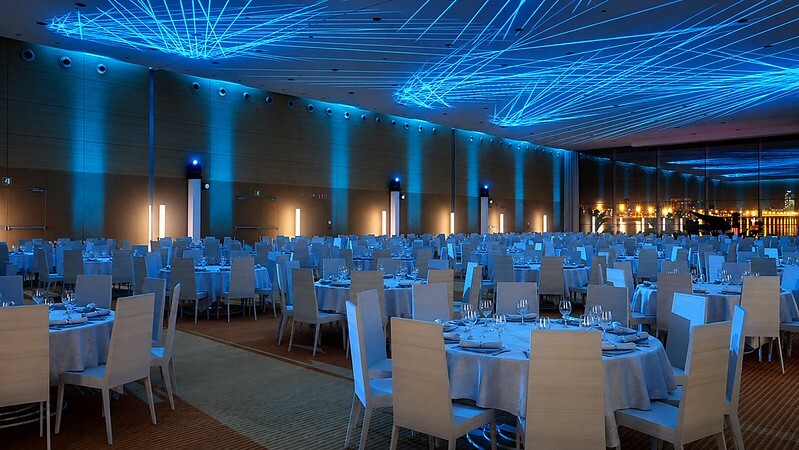
What does a gobo add to an event lighting design?
The greatest creative value of a gobo lies in its ability to combine lighting and visual communication.
Rather than simply illuminating a surface, it projects a purposeful visual element such as:
- A texture.
- A symbol.
- A graphic pattern.
- A brand identity element.
- Personalise the venue according to a creative concept or brand identity.
- Create varied lighting atmospheres using existing compatible fixtures.
- Turn walls, floors, ceilings and architectural features into active components of the event design.
This can help achieve several objectives within a single production, as you can:
When properly integrated into the overall AV production, the gobo becomes part of the visual composition rather than an isolated effect.
When is it not recommended to use a gobo?
A gobo projects a static image. While it can move, rotate or change size, it cannot alter the projected image itself.
If your objective is to display animated content or video, a video projector or LED display is a more appropriate solution.
Gobos may also be unsuitable when people or objects frequently pass between the projector and the projection surface, creating unwanted shadows.
Likewise, in outdoor daytime events or venues with significant ambient light pollution, the projection may become difficult or even impossible, to see because surrounding light overwhelms the projected image.
Identifying these limitations during the planning stage helps avoid issues during installation and event operation.
What technical factors can limit a gobo projection?
The light path should remain as unobstructed as possible.
In spaces with constant attendee movement, scenic structures, furniture or architectural obstacles between the fixture and the projection surface, the image may lose continuity and visual clarity.
Ambient light is another key consideration. The brighter the environment, the harder it becomes for the projection to stand out visually.
Before incorporating a gobo, it is therefore essential to evaluate the actual venue conditions and the specific time during which the effect will be used.
How can you use a gobo at your next event?
Although gobos are based on a centuries-old concept, they continue to create impact thanks to the sharpness, scale and precision of their projections.
For brands, they offer a simple yet elegant way to maintain visual presence throughout a venue without relying on physical signage.
There is also a strategic benefit. If maximising event visibility is important, gobos can help monetise spaces that are difficult to use for traditional screens or printed branding.
At corporate events, common applications include:
- Company logos and brand slogans.
- Event logos and sponsor branding.
- Social media handles and event hashtags.
- Decorative textures and ambient visual effects.
These are only starting points. When planned effectively, a gobo can become a central element of an event’s visual identity.
The key is to integrate it during the technical design phase rather than treating it as a last-minute addition.
A well-designed and properly projected gobo remains one of the most impactful lighting tools available, capable of bringing a brand presence to every corner of a venue.
Where should a gobo projection be positioned at an event?
The location should balance visual impact with technical feasibility.
Useful locations may include:
- Entrances and welcome areas.
- Stages and scenic backdrops.
- Floors and walls.
- Ceilings and architectural features.
- Sponsor areas and brand activations.
Not every location will be suitable for every event. The final decision should always align with both the creative vision and the venue’s technical realities.
How should you choose a gobo design?
The design should begin with the intended objective.
For brand recognition, clear and simple compositions tend to maximise visibility and legibility. For event décor and ambience, textures and patterns can interact with the venue’s architecture to create a more immersive environment.
It is also important to consider how the projection will coexist with the wider lighting design. A gobo can serve as a focal point during key moments or function as a subtle atmospheric element within a larger visual composition.
Defining these decisions during the creative phase helps ensure that the final technical solution supports the desired visual outcome.
How does Novelty approach the use of Gobos within technical AV production?
A gobo delivers the best results when it forms part of the overall technical design strategy.
The decision goes beyond selecting an image to project. It involves determining the role that projection should play within the audience experience, whether that’s reinforcing brand identity, enhancing ambience, transforming architectural surfaces or supporting a key moment within the event programme.
At Novelty, technical AV production is developed from concept through execution, adapting audiovisual solutions to the specific requirements of each project. When gobos are included, this approach makes it possible to align the creative idea with practical considerations such as venue characteristics, lighting equipment, projection positioning and integration with other technical elements.

FAQs about gobos