Back to blog
Found this useful? Add Novelty as a preferred source and see more of our content when you search on Google.
An international agency lands in Barcelona with 300 delegates, a three-day programme and a single ballroom at the W Barcelona that has to become four different rooms in 48 hours: a working session on the first evening, a full-day plenary, an evening show that same night and a closing session the next morning.
That was the brief for this private corporate event, with technical AV production by Novelty Spain. Out of confidentiality and respect for our clients, the client and the event stay private. What we can share is what matters to anyone planning something similar: how it was solved technically.
Event key facts
| Venue | W Barcelona, Great Room (Barcelona) |
|---|---|
| Guests | 300 |
| Event type | Private three-day corporate event |
| Sector | Corporate |
| Client | Confidential |
| Technical AV production | Novelty Spain: video, audio, lighting, rigging, staging and power |
| Technical highlights | 7.5 x 3 m LED wall at 1.9 mm pitch · fully ground-supported rig · main/backup 4K video processing · L-Acoustics Syva audio · one lighting rig for both plenary and evening show |
The real challenge: one room, four shows, 48 hours
The risk in a project like this is rarely the equipment. It is the room. Hotel ballrooms are built for banquets, not for shows: no rigging points, limited power, acoustics designed for speech at a table rather than a presenter on a stage, and a venue that is still operating as a hotel while you build.
The programme looked simple on paper. In practice it meant that the same stage had to read as a working session in daylight mode and, a few hours later, as an evening stage with an entirely different energy, without a reset window long enough to rebuild anything.
The answer was not more equipment. It was a single technical design that could change character through lighting and content rather than through re-rigging. That decision drove everything else: what went on the totems, how the LED was fed, where front of house sat, and how much power we pulled and from where.
No rigging points: designing around ground support
The Great Room offers no usable hanging points, which is the norm rather than the exception in hotels. Everything had to stand on the floor. Novelty Spain built the whole structure as ground-supported rigging:
- Two 4 m totems with a "T" head and 0.5 m extensions at each end, carrying the stage lighting.
- Three 3.85 m totems behind the LED wall, fitted with 4 m pipes to fly a drape and close the back of the stage cleanly.
Ground support is where hotel projects are won or lost. Load paths, floor protection, sightlines and the visual weight of the towers all have to be resolved on the plan, weeks before anyone unloads a truck. We wrote up the longer version here: choosing a rigging supplier for corporate events.
Video: a 7.5 x 3 m LED wall with no single point of failure
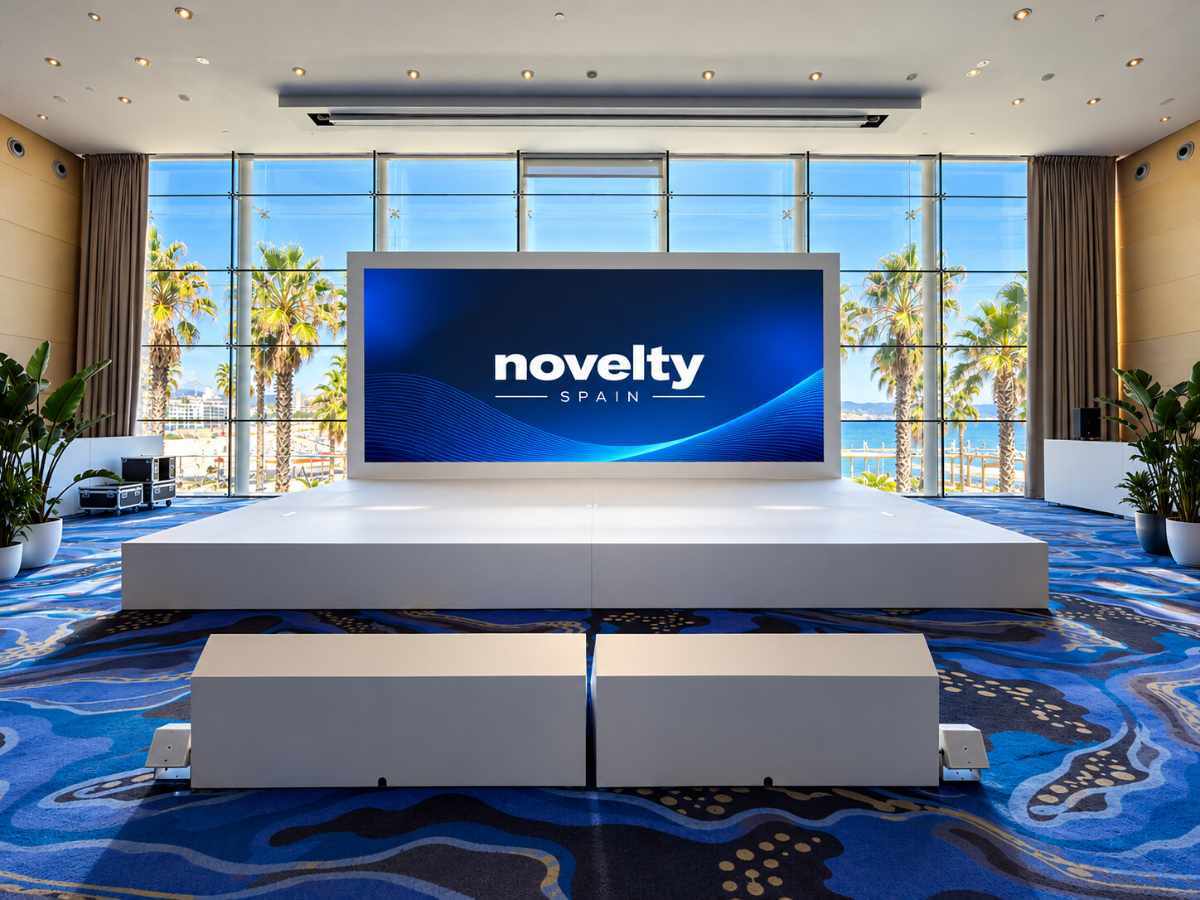
The centrepiece was a T-Rent 1.9 mm MiniLED screen, 7.5 m wide by 3 m of visible surface. The stacking frame sits 15 cm off the floor and the bottom module row stays dark, so the image starts above head height and stays readable from the back of a flat-floor room.
Pixel pitch matters more in a ballroom than in an arena. At 1.9 mm the front row sees the wall, not the pixels, which is exactly what you need when the first table is six metres from the stage.
Behind the wall, the video chain was built for redundancy from the start:
- Two 4K processors in main/backup, so a failure never reaches the screen.
- An Analog Way Zenith 200 as the central switcher, feeding the LED over OPTC fibre. We have written before about how this family of processors handles multi-screen productions.
- Two 65" downstage monitors for the presenters, carrying the current slide and speaker notes.
- Four 75" delay displays around the room, each on its own fibre run so any screen can be re-patched from a single central point.
- An 85" repeater and 43" multiview monitors at control for the technical director, the show caller and general reference.
Source-side, the show ran on four presentation laptops, a dedicated machine for the countdown clock and three MacBooks running Mitti: main and backup for 16:9 playback, plus one for stage backgrounds. That is a lot of machines for a "simple" corporate programme. It is also why nothing stopped: every playback path had a twin.
Audio: intelligibility first
Three hundred people in a carpeted ballroom with a low ceiling is an intelligibility problem before it is a volume problem.
The sound system was built around a compact L-Acoustics design: a pair of Syva and Syva Low as the main PA, reinforced by an identical delay pair at mid-room, with 5XT for front fill and stage monitoring, all driven by LA4X amplification.
Front of house sat at the side of the room: a venue constraint built into the plan from the first drawing. Mixing ran on a Yamaha DM7 console, the larger sibling of the Yamaha DM3, with Shure Axient Digital wireless across 16 receive channels, configured as handhelds and headsets according to the running order.
Stage foldback let presenters hear questions from the floor: a small detail that decides whether a Q&A feels like a conversation or a struggle. Playback and cues ran from a dedicated QLab machine, and the crew stayed together on Hollyland Solidcom intercom.
Lighting: a clean stage and a room that changes colour
In a hotel ballroom, more fixtures rarely mean a better result. Every extra tower adds structure, cable and power to a room that was never designed to carry them.
The final design kept it simple: Fresnels and profiles on the totems for a clean, elegant, well-modelled stage wash and key light, plus uplighters around the room to bring in colour and change the mood of the space between sessions.
The plenary and the evening show then shared the same rig. What changed between them was the state of the room, not the structure in it. This is the principle we set out in our guide to lighting techniques for stage design: in a corporate room, lighting should shape the space and the speaker, not perform on its own.
Power and logistics inside a working hotel
In a hotel, power is planned as carefully as the equipment. Here the distribution was split by discipline to keep noise and risk apart:
- A dedicated 32 A board for the LED wall.
- A 63 A powerbox for sound and lighting, feeding two socapex runs to a shared front-of-house position.
- Wall outlets for the delay displays, chosen by location rather than by convenience.
One full load-in day, three show days and a load-out wrapped by midday on day four. Between those two points the hotel never stopped being a hotel, which is its own discipline and one we apply across AV production in hotels and event venues.
Why international organisers work with a local AV partner in Barcelona
An agency bringing an event to Spain is importing a programme, not a warehouse. What it needs locally is a partner that already knows the venue, the suppliers, the regulations and the crew, and one that can work discreetly when the event cannot be made public.
This is not our first project at the W Barcelona: the same hotel hosted Canalys Forum EMEA 2026, also produced by Novelty Spain. It sits alongside other projects where we have taken on exactly that role for international clients: KubeCon + CloudNativeCon Europe 2026 at RAI Amsterdam, the YSL Beauty Block Party across two venues in Madrid and MWC 2026 at Fira Barcelona, among others.
Different sectors, different event formats, the same requirement: a technical production that holds up under a programme that cannot be paused. With more than 40 years of history, an 8,000 m² warehouse and over 13,000 items of audiovisual equipment, Novelty Spain works with agencies and brands across every sector in Barcelona, Madrid, Valencia and Marbella.
Bringing a corporate event to a hotel in Spain? Tell us the venue and the programme, and we will design the technical AV production around them.

FAQs