Back to blog
Found this useful? Add Novelty as a preferred source and see more of our content when you search on Google.
In event planning, every touchpoint with attendees helps build your brand. And there’s one in particular that attracts more attention than you might imagine: photocalls. The photocall is more than just a space for taking photos. It’s where a large part of the visual content which will later be featured across media, social networks and internal communications is created. A well-executed photocall brings coherence, reinforces brand identity and elevates the overall perception of the event. However, when it’s treated as a secondary element or not planned at all, the results quickly show through flat images, uneven lighting, content that’s hard to reuse or an aesthetic that falls short of the overall AV technical production.
At that point, the event loses not just a photo opportunity, but also control over its image and how it will be perceived beyond the live experience.
In this article, we explore the key factors for designing a photocall for events that work both technically and visually, the most common mistakes to avoid and which solutions best suit each type of project.
Key technical challenges in designing photocalls for events
In many corporate events, the photocall is treated as just another element within the space, without specific technical design. This often leads to inconsistent images, lighting variations between shots, branding that isn’t accurately reproduced or visuals that don’t meet the standards required for communication use.
The challenge in creating a photocall for events is not just looking good in person but performing well on camera in any situation. Every attendee stepping in front of the photocall should get a consistent image, regardless of their position, the timing or environmental conditions.
Additionally, photocalls often coexist with factors that complicate control, such as changing ambient light, reflections on materials, constant foot traffic or limited space. Without proper planning, these elements directly affect image quality.
Common mistakes in photocall events and how to avoid them
Many of the following issues appear repeatedly across different types of events. Identifying them early is key to maintaining professional results:
- Poorly designed event lighting: overly harsh front lighting or uneven distribution creates unflattering shadows and flattens facial features.
- Lack of consistency across the scene: exposure differences between shots or poorly lit areas within the same space.
- Uncontrolled reflections: shiny surfaces or unsuitable materials can create glare that ruins the image.
- Incorrect or inconsistent colours: mixed colour temperatures or uncalibrated lighting that distorts brand colours.
- Framing inaccuracies: misaligned compositions that make images harder to reuse later.
These issues often go unnoticed during the event but become evident afterwards, when the content is used. That’s when a poorly executed photocall shifts from a minor detail to a real communication problem.
Why does lighting in photocalls affect the event’s brand image?
When approached with a technical and strategic mindset, a photocall for events can become far more than a simple photo backdrop. They turn into a key element of the overall experience, where the brand is most visibly expressed, where reusable content is generated and where much of the event’s post-visibility is concentrated.
A well-designed photocall allows you to control how the brand appears on camera, ensure consistency across all images and create a smooth experience for attendees. It also makes it easier to generate high-quality content for social media, press or corporate communications, without the need for post-production fixes.
From this perspective, the photocall provides not only aesthetic value but also functional benefits as it organises guest flow, defines a clear interaction point and reinforces the event’s visual narrative within the AV production.
How to design a professional photocall step by step
To achieve professional photocall results, several technical factors need to work together, including:
- Lighting, the defining factor in camera results: lighting for events is the most important element in any photocall. It affects visibility, depth, texture and colour accuracy. Well-designed event lighting ensures clean images, soft shadows and a visual style aligned with the brand.
- Framing control and visual consistency: defining camera positions and the area where attendees stand is key to ensure uniformity. This guarantees consistent composition across all photos, making them easier to use in future communications.
- Guest flow and experience: a well-integrated photocall should facilitate movement, avoid unnecessary waiting times and improve brand interaction from the very first moment. This depends on both spatial design and coordination with the overall event organisation.
Together, these factors transform the photocall into a strategic tool, strengthening brand identity and optimising content creation during the event.
Which type of photocall works best for your event?
Not all events require the same type of photocall. The context, communication goals and audience profile all influence both design and technical execution. Adapting the photocall to the event format improves not only visual results but also attendee experience and brand consistency.
Photocallsfor corporate settings: clarity and consistency
In corporate events, the main goal is to project a clear, consistent brand image. The photocall is typically clean, with clearly defined backgrounds and visible branding elements.
From a technical perspective, priorities include:
- Uniform lighting to ensure consistency across all images
- Accurate reproduction of corporate colours
- Stable, repeatable framing
The result should be content that can easily be reused in professional networks, internal communications or media.
Photocalls at trade shows and conferences: visibility and functionality
In environments such as trade shows or congresses, the photocall serves a dual purpose: attracting attention and enabling content creation in a dynamic, high-traffic setting.
Key elements include:
- Lighting that stands out against the venue’s general context
- Visual elements that capture attention from a distance
- A functional design that supports continuous attendee flow
The challenge here is maintaining visual standards in a less controlled set.
Photocalls for luxury settings: detail, lighting and perception
In formats such as galas, fashion shows or exclusive celebrations, the photocall becomes a central part of the experience. Every detail matters, and perceived quality is directly linked to the final image.
In these cases, lighting becomes critical. Be sure to implement:
- Precise, soft, well-shaped light
- Careful control of shadows and reflections
- Seamless aesthetic integration with the area
In high-end productions, the photocall evolves from a functional setup into an extension of the event’s visual language. Lighting, materials and surroundings should work together to ensure flawless on-camera results.
A clear example of this approach is the Carolina Herrera fashion show in Madrid, where AV technical production required absolute control over image capture at every point. In this type of event, every detail (from light quality to visual consistency) directly impacts brand perception and the value of the generated content.
Beyond the type of event, it is also important to consider how the lighting is installed. In practice, the main difference lies in whether fixtures can be rigged overhead or need to be floor-mounted using stands or supports.
This decision affects not only the visual outcome but also light uniformity, shadow control and integration within the space. For this reason, the lighting setup is one of the elements that truly defines the final result.
How does lighting impact photocalls?
When it comes to a photocall for events, the difference between a standard result and a truly professional one lies in how well lighting is controlled. It’s not just about illuminating the space but about doing so with precision, stability and consistency in every shot.
Factors such as varying positions, ambient lighting or mixed colour temperatures can directly affect the result if they’re not managed during the technical design phase. That’s why using equipment that allows control over intensity, direction and colour temperature is essential.
In this context, equipment such as the Astera Leo Fresnel (a high-performance LED spotlight with an integrated battery) makes it possible to control light with greater precision and achieve a more natural, even result. Its compatibility with the Astera ecosystem also makes it easy to integrate into demanding productions.
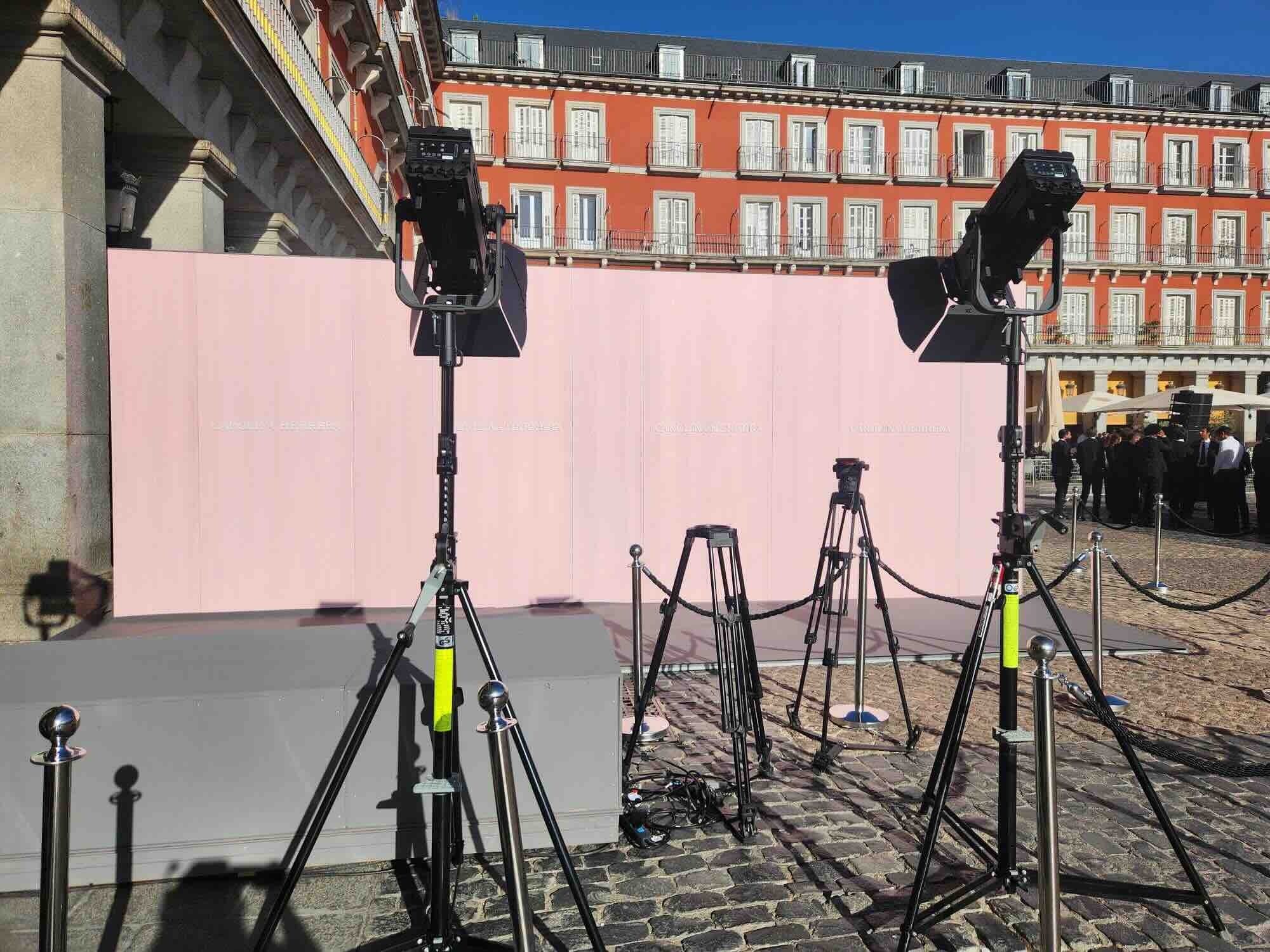
As for the number of fixtures required, there is no fixed formula. It depends on factors such as backdrop materials, mounting height and lighting position. As a general reference, one fixture per 1.5 metres of width can be considered, although this should always be adapted to the specific conditions of each project.
Its ability to adjust intensity, colour temperature and beam angle allows for precise subject lighting, ensuring consistent results while simplifying on-site operation.
At Novelty, every project is approached with a technical and creative mindset focused on precision and consistency at each stage of the event. If you’d like to explore how the Leo Fresnel by Astera can enhance your lighting for events, you can browse our catalogue for lighting solutions designed for demanding technical environments.
And if you’re planning a tailored event and need a specialised partner in technical AV production, feel free to get in touch and request your AV quote.

FAQs about photocalls for events