Back to blog
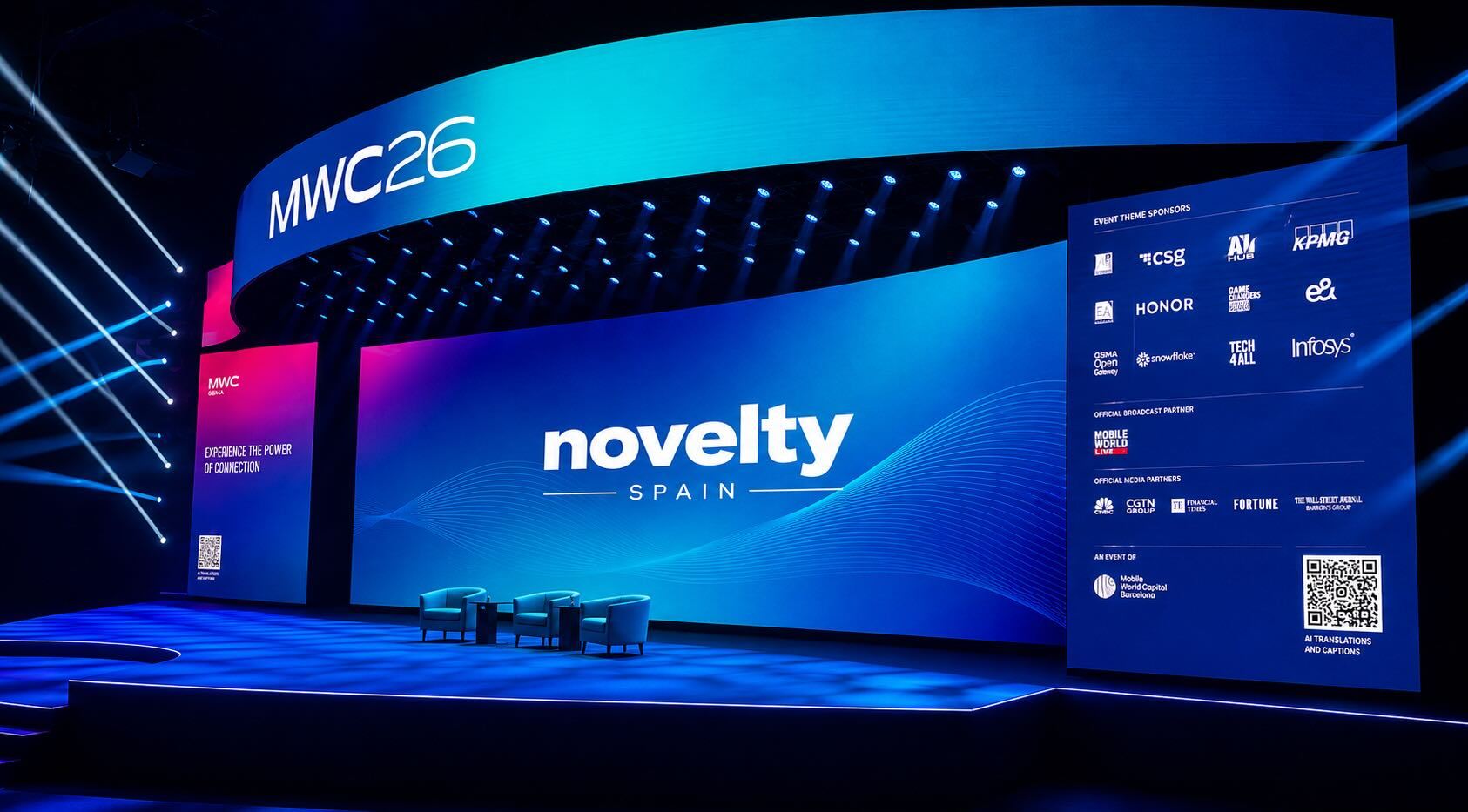


MWC 2026 once again placed Fira Barcelona at the centre of the world’s major international tech events. From the 2 to the 5 of March 2026, the Mobile World Congress united brands, speakers, technical teams and global audiences together in Barcelona, in an environment where every audiovisual detail had to work in sync.
In events of this scale, technical AV production is not just an operational matter. It is the infrastructure that allows every keynote, broadcast, visual asset and live experience to run with no margin for error.
In this edition, Novelty Spain participated as the strategic AV partner for the technical audiovisual production of the GSMA MWC Main Stage and the MWC Broadcast Stage, integrating lighting, sound, video, LED, rigging, broadcast, intercom, networks, power and technical support for a complex, connected operation suited for live viewing.
MWC 2026 broken down: GSMA’s big tech event at Fira Barcelona
Project technical sheet:
- Event: Mobile World Congress 2026
- Client: GSMA / Fira de Barcelona
- Dates: March 2-5, 2026
- Location: Fira Gran Via, Barcelona
- Technical AV production: GSMA -MWC Main Stage + MWC Broadcast Stage
- Integrated technical services:
- Lighting
- Sound
- Video
- LED
- Rigging
- Broadcast
- Intercom
- Networks
- Power
- Technical support
- AV partner: Novelty Spain
Technically speaking, what does it take to produce a major tech congress?
The AV production of an international technology congress combines multiple disciplines that need to work in sync.
It is not simply about installing equipment. The real challenge lies in making sure that lighting, sound, video, broadcast and technical control operate as one connected ecosystem.
When this coordination fails, common issues can appear, such as:
- Uneven sound coverage
- Signal delays
- Broadcast problems
- Visual inconsistencies
- Coordination errors between technical teams
- Operational risks during live sessions
At a global event, where every session may be broadcast internationally, technical redundancy and pre-production planning are essential
How the triangular Main Stage was designed for MWC 2026
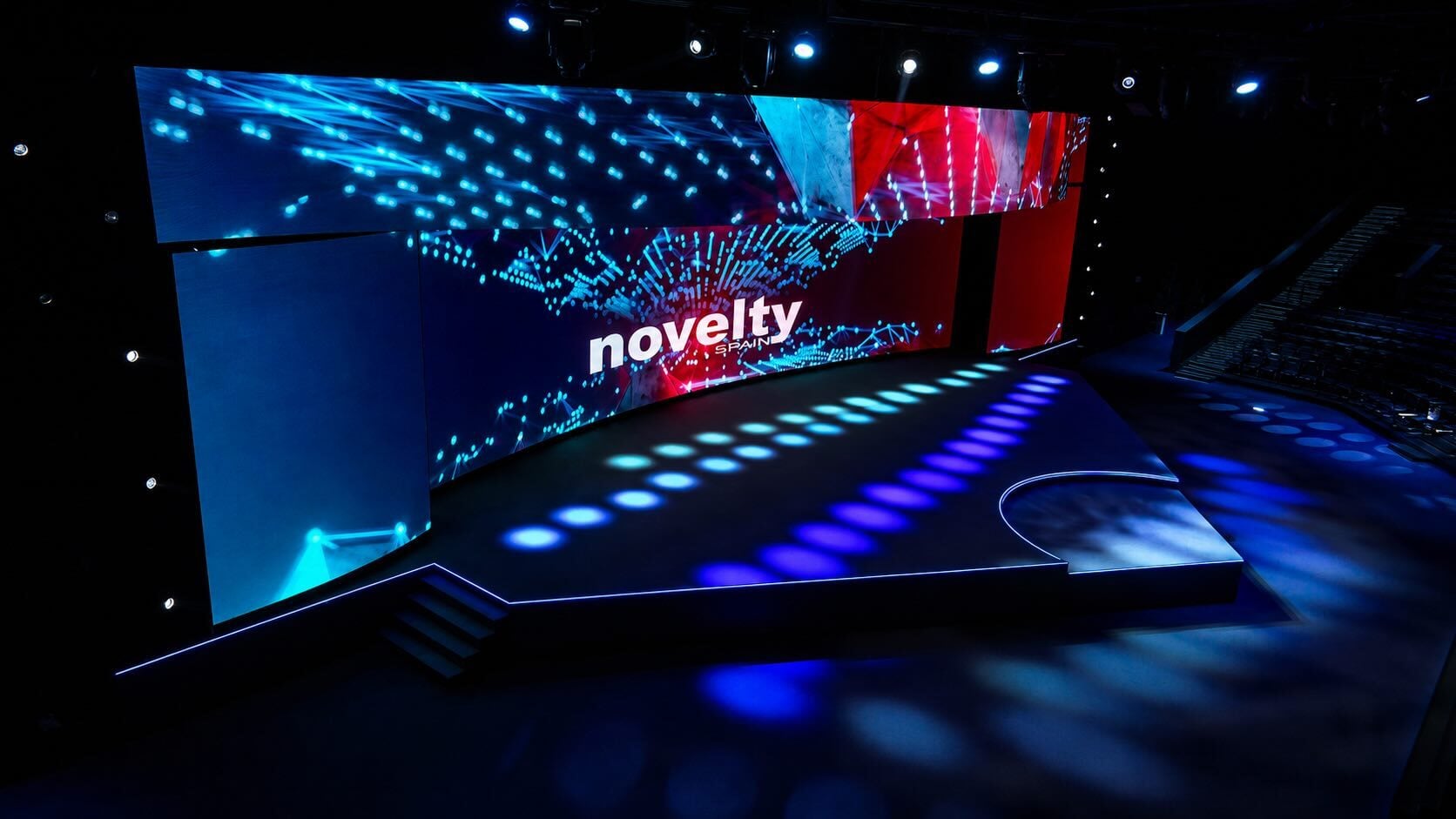
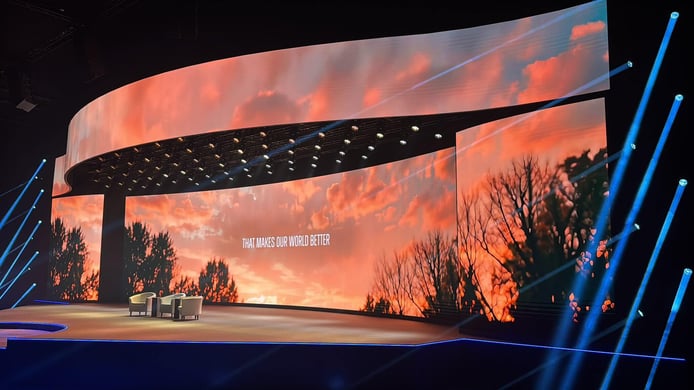
The Main Stage at MWC 2026 was redesigned with a triangular stage that influenced the system positioning, sound design and all sightlines for both the audience and the speakers was taken into consideration.
.jpg?width=804&height=448&name=MWC26%20(3).jpg)
Given the complex nature of the space , every discipline had to work as part of a connected system to support the execution of a smooth live operation. The key elements were:
- Video and LED to adapt content and screens to the new layout.
- Sound to ensure uniform coverage and acoustic control.
- Lighting to enhance scenic depth and improve camera readability.
- Rigging to support structures, loads and suspended elements.
- Broadcast and intercom to coordinate production and communication between teams.
Coordination between BOH, FOH, backstage and technical control made it possible to centralise decisions and reduce the margin for error during keynotes, presentations, external feeds and audiovisual content.
In addition, the interconnection between the main stage and the broadcast stage enabled signals to be sent and received between spaces, a key point for a production prepared with live streaming and recording in mind, as well as the content distribution from a central location.
The result was a stage set up that worked a complete technical system: architecture, content, signal, sound and lighting working in sync to support one of the central spaces at Mobile World Congress 2026.
.png?width=704&height=392&name=MWC26%20(1).png)
How do you light a major tech event like MWC 2026?
The lighting for MWC 2026 was designed to support two very different needs: the visual strength of the main stage and the precision of the broadcast stage , where every session also had to work for the camera.
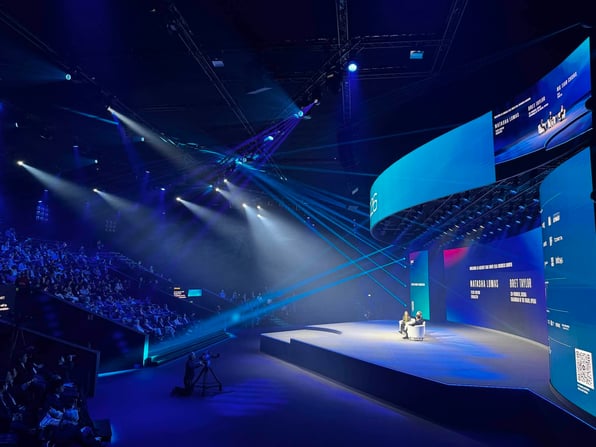
The lighting design for the main stage was developed around the triangular geometry of the set, enhancing its architectural presence and creating a strong sense of depth and dimension throughout the space. A fully integrated control and networking infrastructure ensured seamless synchronisation of lighting, video and show elements, delivering a reliable and responsive environment for the duration of the event.
On the broadcast stage, lighting was focused on interviews, presentations and live content. The objective was to achieve a polished, consistent image ready for broadcast, while preserving the aesthetic of the space and avoiding interference with nearby stand areas.
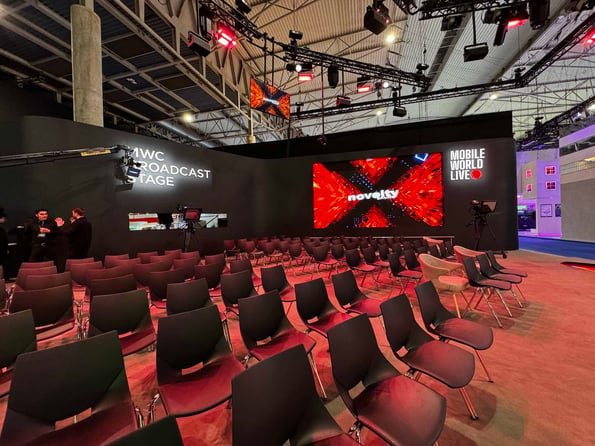
The system included specific resources such as:
- Profile fixtures for front light
- Fresnels for backlight and modelling
- SkyPanels to soften shadows
- SGM Q8 fixtures to wash the space with colour
- Ayrton Rivale fixtures for textures and specific effects
- On-air light signals to indicate recording status
How was clear sound guaranteed across the MWC 2026 stages?
Sound was one of the key elements that allowed MWC 2026 to function smoothly across all spaces. On the main stage, the PA system was designed to cover a large-format auditorium, with main reinforcement, delays, front fills and low-frequency support.
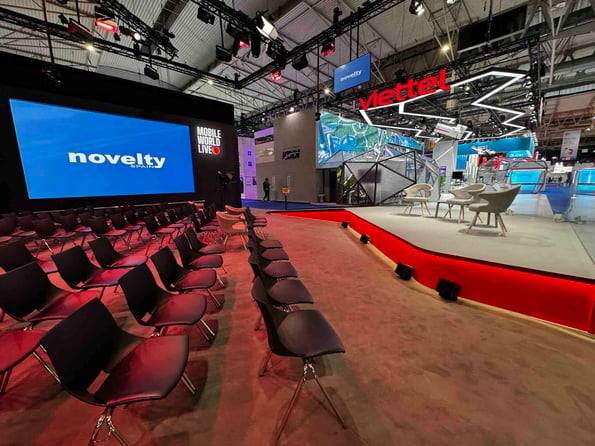
The broadcast stage, faced a different challenge: an open, stand-style space with reduced capacity and the need to avoid sound spill into nearby areas. To solve this, the system was designed with loudspeakers directed towards the audience, reinforcement in external areas and front fills for the first rows.
Microphones and audio routing were also essential to the flow of the event. The event included:
- Wireless systems for speakers and interviews
- Ambience microphones for room capture
- IEM and monitoring for technical control
- Dante routing to reduce cabling and optimise signals
- Intercom connected between the main stage, broadcast stage and OB unit
- Signals prepared for recording, streaming and production
LED screens and video at MWC 2026: keys to the visual production
The video and LED design for MWC 2026 had to adapt to the new main stage layout and to the needs of an event with multiple signals, content formats, presentations and live workflows.
On the main stage, the installation integrated LED screens, support monitors, DSM screens, content distribution systems, recording and signal feeds for backstage. The 4 x 1.5 m DSM were created in Led 1.9mm, served as visual support for the stage, with a resolution of 2048 x 768 px per unit.
On the broadcast stage, the LED screen was configured with dimensions of 5.5 x 3.5 m, with a visible area adapted to a 16:9 format. This decision made it possible to maintain a clean camera composition, avoiding black bars and optimising the image for recorded or broadcast sessions.
The video operation was supported by an advanced control infrastructure that included:
- Analog Way Aquilon processors
- Modulo Pi systems
- HDMI and SDI matrices
- Fibre converters
- Control and multiview monitors
- Signals for prompter, DSM, streaming and backstage
- Main and backup equipment to ensure continuity
Rigging at MWC 2026: structures, motors and safety at Fira Barcelona
The stage set for MWC 2026 required precise structural planning. The triangular architecture of the main stage involved a complex technical distribution, with grids, motors, trusses, suspended elements and auxiliary structures working as part of one system.
Here are a few figures to show the scale of the installation:
- 148 x 500 kg D8+ motors for the Audience Roof
- 37 x 250 kg D8+ motors for the Stage Roof
- 28 x 400 kg D8+ motors for the LED Banner
- 21 x 320 kg motors for the perimeter structure
- 1T motors for suspended subwoofers
On the broadcast stage, rigging was adapted to a more compact format but remained technically demanding. The structure included central trusses, motor points and suspended elements for sound, lighting and video, including 250 kg and 320 kg Liftket motors.
Broadcast at MWC 2026: production, streaming and live signal
The broadcast infrastructure for MWC 2026 was designed to support live sessions, interviews, recordings, streaming and shared signals between spaces.
The production combined elements such as:
- 4K, PTZ and JIB cameras: these made it possible to cover wide shots, details, speaker tracking and dynamic movements during interviews and live sessions.
- Multicamera production: this provided flexible coverage for local content, recordings and broadcasts with different production requirements.
- vMix and remote callers: these helped manage streaming compositions, presentations, videos, lower thirds and possible remote contributions.
What happened behind the technical production of MWC 2026?
Backstage acted as the operational centre of the project. It was the place where technical control, the speaker suite, monitors, racks, operators, signal coordination and live support came together.
- Preparation before the congress: setup, equipment preparation, signal tests, screen adjustments and audio checks began weeks before the official opening of the Mobile World Congress.
- Coordination between technical areas: video, sound, lighting, rigging, broadcast, networks, power and intercom worked under the same operational logic.
- Live technical support: every technical area was prepared to anticipate incidents, adapt signals and maintain the rhythm of the event.
This type of technical production is not an isolated case. At Novelty Spain, we have worked on different international events where audiovisual coordination, stage set up, broadcast and technical precision have been key to turning an idea into a memorable experience. You can discover more success stories in our article on technical production for international events.
What GSMA says about working with Novelty Spain
"Novelty Spain, have been an exceptional AV Production partner for our MWC Main Stage and Broadcast Stage, delivering the highest level of technical quality and professionalism. Their team’s expertise, reliability, and attention to detail made the entire production process smooth and efficient. It has been a genuine pleasure working with them on the technical & production of both stages."
Laura Ennis
Director of Multi-media & Production Events | GSMA
Delivering an event such as MWC requires more than audiovisual equipment. It requires a partner capable of integrating technology, people and operations under one shared vision.
What to consider when choosing an AV partner for a tech congress
At a tech congress like the Mobile World Congress, choosing an AV partner is not just about hiring audiovisual equipment. The key is working with a team capable of coordinating broadcast, lighting, sound, rigging, video, networks and technical support under one operational direction, especially when the event combines a main stage, backstage, streaming and live production.
|
Factor |
Risk if it fails |
What an expert AV partner like Novelty provides |
|
Broadcast |
Signal loss |
Redundancy |
|
Lighting |
Poor image quality |
Perfect camera readability |
|
Rigging |
Delays |
Safety and optimisation |
|
Intercom |
Operational errors |
Coordination |
Do you want your brand to shine at MWC 2027? Let’s talk about your next project. At Novelty, we can help you design solid, precise and memorable audiovisual production to stand out at one of the year’s biggest technology events. Tell us what you have in mind and we’ll see how we can help.
FAQs about technical AV production at MWC 2026