Back to blog

Found this useful? Add Novelty as a preferred source and see more of our content when you search on Google.
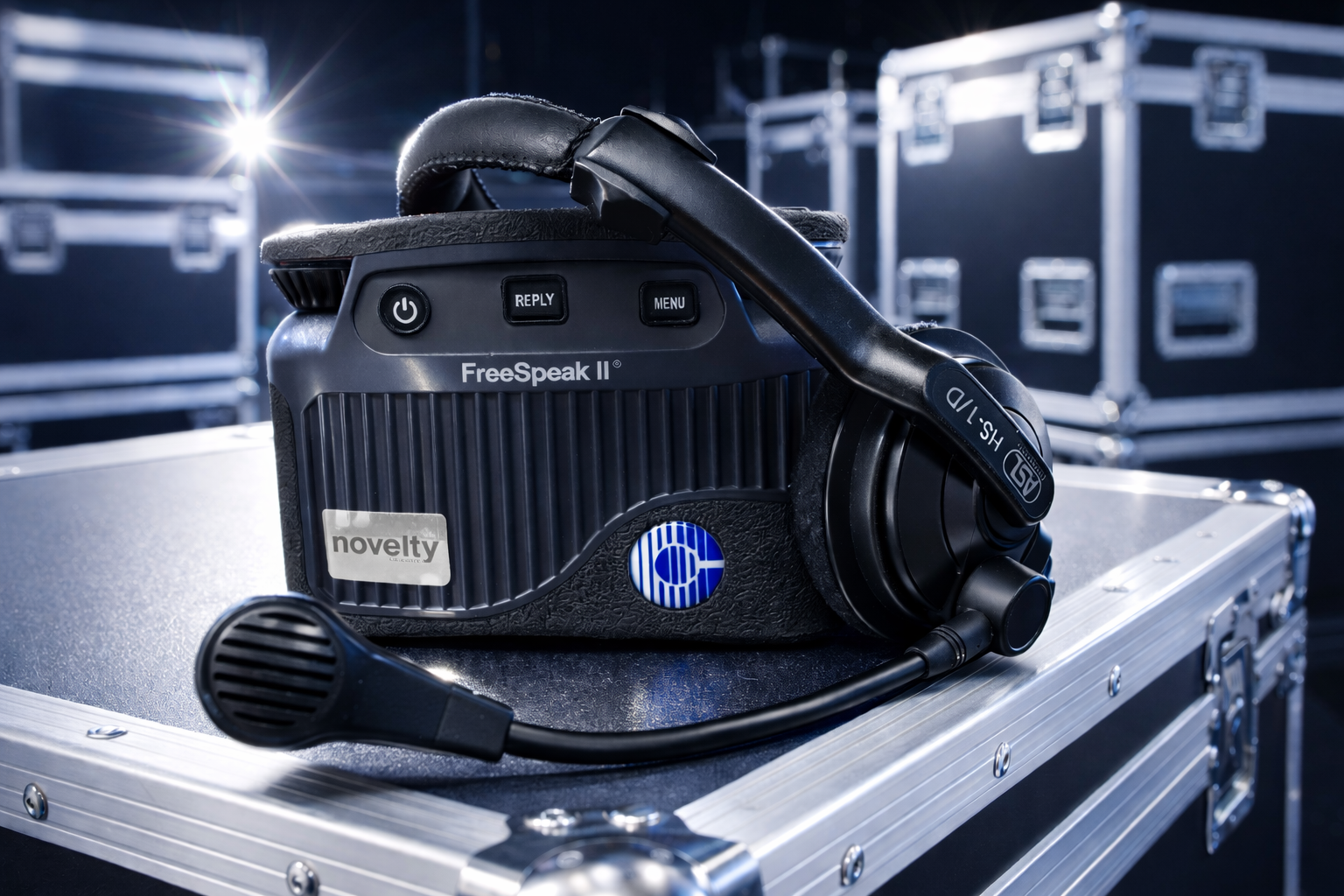
In productions where every second counts, having strong technical equipment is not enough. Every team needs to stay perfectly aligned. That is where the intercom becomes a critical tool, enabling clear, immediate communication without interference during event organisation.In events, an intercom is a professional internal communication system that allows every team involved in AV technical production to coordinate instantly. From show calling, sound and lighting to stage managers and technical direction, intercom acts as the invisible channel that keeps everything under control.
These systems are mainly used by technical crews working on live events such as conferences, trade shows and corporate events. Their role is not simply to help people communicate but to ensure that AV production runs smoothly and without mistakes, even in complex environments with multiple stakeholders involved.
The importance of strong communication in AV technical production
At any event, the difference between a correct execution and an exceptional one often comes down to an often-unseen factor: internal communication across the team.
One of the most common issues in AV technical production is live timing errors. A late slide change, a video cue that comes in out of sync or lighting that misses a key moment can completely disrupt the audience experience.
On top of that, poor coordination between departments creates even more risk. When sound, video, lighting and technical direction are not aligned in real time, mistakes multiply and become much harder to fix on the spot.
The impact is direct as:
- The event narrative loses strength.
- The attendee experience is affected.
- The organiser’s brand perception weakens.
For experienced professionals, this type of failure is not an option. They need control, precision and technical reliability. That is only possible when communication flows smoothly.
Intercom in events: 3 keys to flawless technical communication
1. Full-duplex communication vs. push-to-talk
Not every coordination system works in the same way. In professional environments, understanding the difference between full-duplex and push-to-talk is essential:
A full-duplex system allows users to speak and listen at the same time, just like in a normal conversation. It is ideal for fast-paced productions where immediate responses are critical.
Push-to-talk, by contrast, requires the user to press a button before speaking. Although it can be useful in certain situations, it introduces friction that may slow down the exchange of information at key moments.
Choosing one system over the other has a direct impact on the operating speed of the technical team.
2. Channels, roles and technical hierarchies
At a professional event, not everyone needs to hear everything. A well-configured intercom events setup makes it possible to organise communication according to:
- Roles, such as show calling, technical crews or stage management
- Departments, such as video, sound or lighting
- Decision-making levels
This reduces unnecessary noise and ensures that each professional receives only the information that matters to them, improving efficiency and helping to reduce mistakes.
3. Integration with other AV systems
An intercom does not work in isolation. In advanced productions, it integrates with other systems used in AV technical production, such as:
- Multi-camera direction
- Broadcast systems
- Lighting control or media servers
This integration makes it so that communication stays aligned with execution, creating a technical ecosystem where decisions and actions happen in real time.
The benefits of an intercom: how does it optimise AV technical production?
Using intercom systems at events does more than improve coordination. It changes the way AV production is managed and delivered. In environments involving multiple teams, tight schedules and constant changes, having a reliable communication channel is not just an advantage but an operational requirement.
An intercom allows teams to communicate live decisions, anticipate incidents and keep every department aligned without delays. The result is not only smoother execution but also greater control over the event. This is especially important for agencies and brands that need to meet international technical standards.
Some of the main benefits include:
- Real-time coordination between teams: an intercom allows every department to work as one unit. Direction, video, sound and lighting can stay synchronised to the second, adjusting to changes without intermediaries or delays. This is especially critical in live events where there is no margin for error.
- Fewer live technical errors: clear, continuous communication reduces mistakes such as unsynchronised cues, poor timing or execution failures. Teams can anticipate key moments and react immediately to any issue.
- Greater operational efficiency in complex events: in productions with multiple spaces, stages or distributed teams, an intercom becomes the central coordination point. It shortens response times, avoids duplication and improves decision-making, allowing for a smoother and more controlled execution.
Types of intercom systems for professional events
Not every event requires the same type of system. Choosing the right intercom depends on the environment, scale and technical complexity of the production.
Wired systems: stability in critical environments
Wired systems remain a reliable solution in environments where stability is the top priority.
Because they do not rely on wireless signals, they provide constant communication without interference. This makes them a common choice in studios, controlled sets or events where mobility is not a decisive factor.
Wireless intercom systems: flexibility and mobility
In live events, where teams are constantly on the move, wireless intercom systems are often the preferred option.
They allow technicians to move freely without losing communication, making operations easier in dynamic stages, trade shows or large venues. That said, they require careful planning to ensure signal coverage and stability.
Matrix systems: advanced control for large-scale productions
In large-scale productions, matrix systems provide a higher level of control.
They make it possible to manage multiple channels, users and configurations from a central point, adapting to complex structures involving numerous teams and roles. These systems are often used for international events, broadcast environments and productions with high technical demands.
What should you consider when choosing an intercom system?
Choosing the right system is not only a technical decision. It is also a strategic one. Here are the main factors to consider when decision time comes around:
- Scalability according to the event type: a corporate event is not the same as an international conference or a broadcast production. The system must adapt to the size and evolution of the project.
- Signal coverage and reliability: especially with wireless intercom systems, ensuring a stable signal is key to avoiding communication interruptions.
- Compatibility with other technical equipment: the intercom system should integrate with the wider audiovisual setup to guarantee smooth and coordinated operations.
- Ease of use for the operational team: in live environments, there is no time for complex configurations. The system should be intuitive and accessible for every technical profile involved.
Want to avoid technical mistakes at your event?
Many event issues are not caused by technology itself but by a lack of coordination. An intercom helps align teams, reduce mistakes and execute every cue with precision in live environments.
Investing in the right system and working with a technical partner that knows how to integrate it properly means gaining more control, safety and technical quality. Contact Novelty to explore the available design options or request your AV quote for full technical support and complete AV production solutions.